

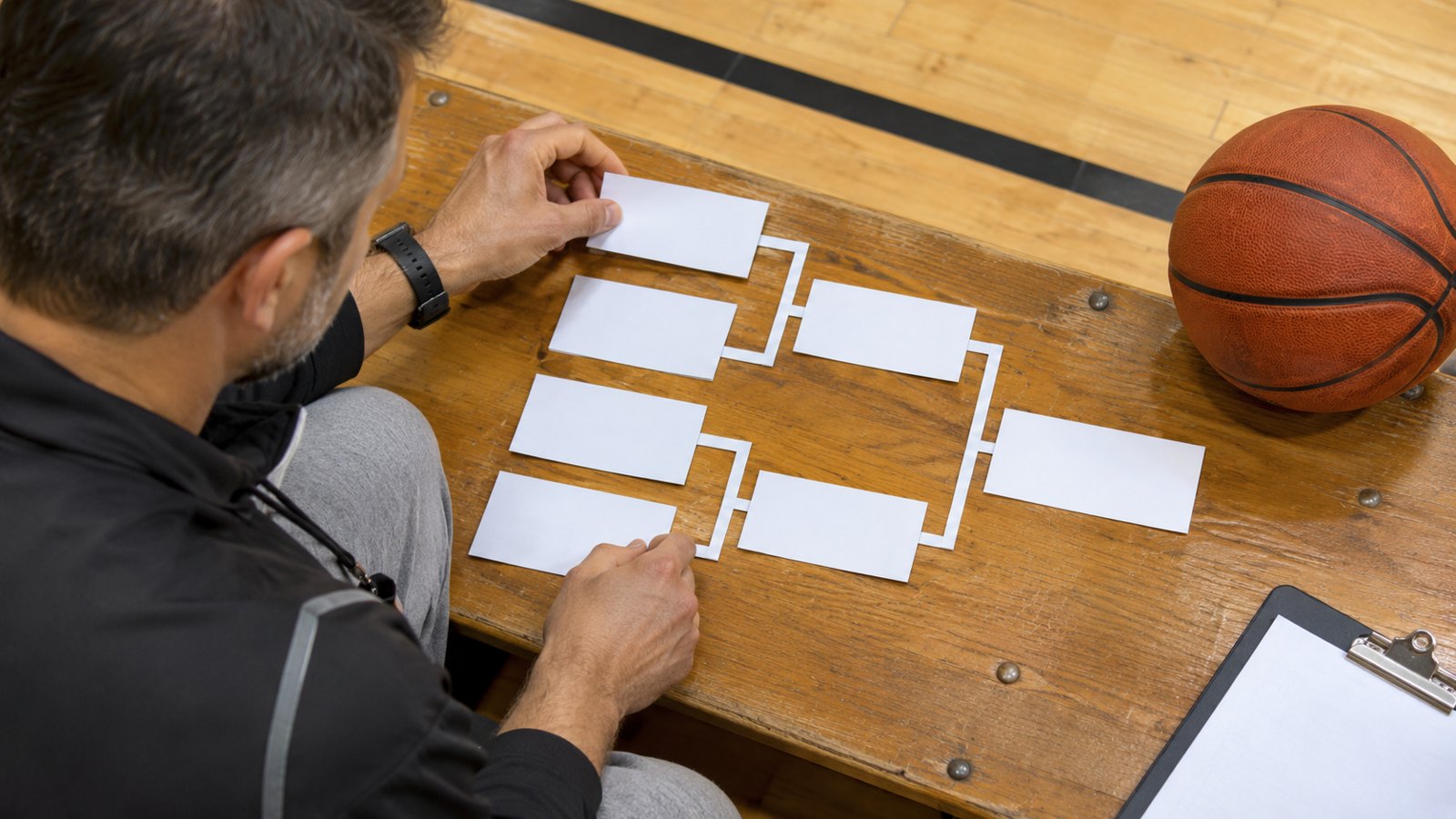
Basketball Tournament Formats: Round Robin vs. Elimination
The best basketball tournament format depends on the games you want to guarantee, the court time you have, and how you want to decide a winner. Single elimination uses the fewest games. Round robin gives every team a game against every other team. Double elimination gives teams a second chance after one loss. Pool play followed by a knockout stage can balance participation with a clear final.
Start with your event promise, then calculate the games needed to deliver it. The examples below assume eight teams, no withdrawals, and completed games without replays or separate consolation matches.
Compare the main formats
| Format | Games for eight teams | What each team can expect |
|---|---|---|
| Single elimination | 7 | At least one game; one loss ends the team's run. |
| Single round robin | 28 | Seven games against seven different opponents. |
| Standard double elimination | 14 or 15 | Two losses eliminate a team; championship reset may add a game. |
| Two pools of four, then semifinals and final | 15 | Three pool games; top two in each pool advance. |
Single elimination: the shortest route to a champion
In single elimination, every game removes one team. An eight-team bracket needs four quarterfinals, two semifinals, and one final: seven games. More generally, a completed single-elimination competition with N teams needs N minus one games to produce one champion.
This format is useful when court time is limited or teams enter expecting a knockout competition. The tradeoff is participation: half the field leaves after its first game. If teams travel a long distance or pay a substantial entry fee, be explicit about that possibility before they register.
Seeding affects the path through the bracket. Publish how seeds are assigned and what happens if a team withdraws. Adding a third-place game or consolation bracket changes both the game count and the schedule.
Round robin: more opponents and more court time
In a single round robin, each pair of teams plays once. The game-count formula is N × (N − 1) ÷ 2. For eight teams, that is 8 × 7 ÷ 2, or 28 games. Each team plays seven times.
Round robin works well when the event prioritizes participation and standings across several opponents. It can demand much more court time than organizers first expect. At an assumed 50-minute slot, 28 games consume 23 hours and 20 minutes of court time before additional breaks or delays.
Publish the standings rules, including how tied records are resolved. Do not assume all basketball competitions use the same tiebreak sequence. The event's adopted rules should determine it.
Double elimination: a second chance with a more complex schedule
A standard double-elimination bracket eliminates a team after its second loss. Teams move between a winners' bracket and a losers' bracket, creating more dependencies than single elimination.
For eight teams, a standard format uses 14 games if the undefeated finalist wins the championship game, or 15 if a reset game is required. A reset allows the previously undefeated finalist to take a first loss without being eliminated immediately. Formats with a one-game final and no reset use a different championship convention; make that choice explicit.
This structure suits events that want a second chance without a full round robin. It still needs careful planning: a team advancing through the losers' bracket may have several games close together. Check recovery time and leave room for the possible extra final.
Pool play plus playoffs: a practical eight-team example
Split eight teams into two pools of four. Each pool plays a single round robin, which requires six games per pool. With 12 pool games, two semifinals, and one final, the tournament has 15 games.
Every team gets three games. The top two teams in each pool advance. You could pair Pool A's first-place team with Pool B's second-place team, and vice versa, provided that crossover is published in advance.
At 50 minutes per game, the total is 12.5 court-hours. Two courts reduce the theoretical playing-time requirement to 6 hours and 15 minutes, but that is only a capacity floor. Semifinals must wait for qualifying results, the final must wait for both semifinals, and teams need appropriate rest. Build the actual sequence before announcing the event duration.
Choose the format your resources can support
Write down four numbers: team count, available courts, available hours, and desired minimum games. Calculate the game count for each candidate format, then place the games on a schedule. Include turnover, recovery periods, staffing coverage, and a delay buffer.
A format is ready to publish when you can explain who advances, how ties are resolved, how many games teams receive, and what happens when a team cannot continue. A simple format delivered clearly is better for coaches than an ambitious structure that changes during the day.
Once your format is settled, create your Ticksterz organizer account to bring tournament planning into one workspace.